| |
| 1455 - The Wars of the Roses |
| Everyone knows that the Wars of the Roses were fought between the counties of Lancashire (who wore a red rose) and Yorkshire (wearing a white rose). This civil war lasted for 30 years (1455 to 1485); killing so many of the aristocracy that good King Henry VII, who had to destroy the deceitful murderer Richard III, created a new nobility. |
| The Wars of the Roses broke out in the gardens of the Inns of Temple in London. York and Somerset were having an argument when Somerset plucked a red rose from a nearby bush and said, “Let all of my party wear this flower!” York, not to be outdone, picked a white rose to be the emblem of his party. |
| It would appear that someone has been telling lies! In the 16th. century under the reign of Henry Tudor scholars rewrote history to legitimise his claim to the throne and it is this version we know today. As they say in war the victor writes history or his friends do. |
| Although many nobles were killed there lines didn't. 25% of noble lines did vanish in this time but half of them because they did not produce male heirs. |
| The 'war' was actually three wars with peace agreements in between them; although the agreements did not last very long. The three are often split into the years from 1455 to 1464, 1469 to 1471 and 1483 to 1487. In fact there was only around 420 days of actual fighting in the whole of the 32 years, with the longest campaign lasting only four months. |
| The sharp eyed amongst you may have noticed that the wars appear to have ended in two different years! This depends on whether you think the war ended at Bosworth (1485) or Stoke (1487). |
| This 'civil' war was in fact a dispute for power between rival noblemen and their followers. The house of York actually got its support from the Midlands and the South while supporters of the house of Lancaster came mainly from Yorkshire. Confusing ain't it! |
| Sadly despite what Shakespeare said York was in the north in May 1455, when the roses incident is said to have taken place, and there is no evidence that the red rose was even used by the Lancastrians during the wars. |
| Before Towton (see later) the battles had been, to our eyes, strange affairs as Phillippe de Commyne noted in his memoirs: |
| "It is the custom of the English that, once they have gained a battle, they do no more killing, especially killing of the common people; for each side seeks to please the commons ..... King Edward told me that in all the battles he had won, the moment he came to victory he mounted a horse and shouted that the commons were to be spared and the nobles slain. And of the latter, few or none escaped ..... The realm of England enjoys one favour above all other realms, that neither the countryside nor the people are destroyed nor are buildings demolished. Misfortune falls on soldiers and nobles in particular ..... " |
| So much so that after the first battle of the war, at St. Albans, out of the 5000 men involved there was reported to be only 300 casualties. |
|
 |
The Battle of Towton |
| In mid-February 1461, the Lancastrians had defeated the Yorkists at St. Albans. For a number of reasons they were unable to consolidate this and take London. Instead King Henry tried to regroup his army at Dunstable. Many of Henry's men, who were unpaid and hungry, simply deserted and set off for home. Meanwhile King Edward was able to gather together a large force and was welcomed into London and crowned King by the people who feared, rightly, that the Lancastrian army simply wanted to plunder the city and rape their womenfolk. |
| After the Yorkists had entered London, Henry VI, Margaret of Anjou, Prince Edward and the remains of the Lancastrian army, marched to York pillaging as they went and leaving havoc and misery behind them. By retreating the Lancastrians effectively surrendered the military initiative to the Yorkists. |
| The Lancastrian army camped outside the walls of York and Henry tried to reassemble his army. Edward did the same in London. On the 11th. of March Edward's men left London on their way north. Edward himself left London on the 13th. and went to St Albans gathering new recruits as he went. By the 22nd. Edward had arrived in Nottingham, where he was informed that 30,000 Lancastrians were positioned to defend the river crossing at Ferrybridge in Yorkshire. By the 27th he had reached Pontefract with an army of 25,000. So that on the day of the battle the two armies had between 60,000 and over 100,000 men - possibly two per cent of the total population of England, which was even greater than the population of London. |
| The Lancastrian army was predominantly northern including at least nineteen peers - whilst the Yorkists had only eight. Somerset, commander of the Lancastrians, was aged twenty-four, while Edward, commander of the Yorkists, was eighteen. |
| On the 28th. of March Edward sent Lord FitzWalter and his men to secure the bridge over the River Aire, south of Ferrybridge, but they were attacked by Lord Clifford who lead a large contingent of cavalry. FitzWalter and most of his men were killed and Warwick, who was with him, was wounded in the leg. When the news of this disaster spread through the Yorkist ranks morale plummeted. Edward and his captains were worried that this would affect their army's performance, but Warwick saved the day in dramatic fashion when he killed his horse in full view of his men and vowed that he would rather fight on foot and die with them than yield another inch. |
| Meanwhile, Henry offered a truce as he was a religious man and did not want to fight on Palm Sunday but this was refused. Edward then sent in the Yorkist vanguard under the command of the Duke of Suffolk, which pushed the Lancastrians back to the end of the bridge. On hearing the bridge was almost taken, Edward marched the main body of his army to Ferrybridge to aid Suffolk, himself going on foot to fight with them. |
| In order to stop the Yorkists the Lancastrians destroyed the bridge. The Yorkists then tried to built a narrow raft but this was also destroyed. While this was going on Fauconberg had taken a force through Wheldale to cross the Aire at Castleford. Clifford was busy defending the bridge and met Fauconberg coming down the side of the Aire. There followed an intense struggle on the Brotherton marshes and although Clifford fought with heroic courage he and his men became surrounded and overwhelmed so they retreated towards the village of Saxton; unwisely at this point he loosened his gorget and was killed by an arrow in his throat. |
| That night the Yorkist army were able to set up camp on the northern side of the river while Edward lodged at Pontefract Castle. At dawn on the 29th. of March 1461 Palm Sunday both armies found themselves in the midst of a terrible snowstorm. The Yorkists began their march north, and at eleven o'clock in the morning Edward drew up his men in battle formation, their lines stretching for a mile along a ridge. At the same time the Lancastrians took up their position half a mile to the north of the Yorkists on high ground a hundred feet above the village of Towton, six miles north of Ferrybridge. |
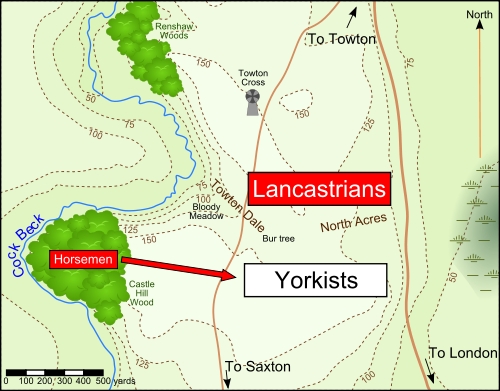 |
| Initial Positions Of The Armies |
| Copyright: Wikipedia |
| The armies were now facing each other across what would shortly be known as the 'Bloody Meadow' and a field which is still called North Acres. From a military point of view the Lancastrians were in a commanding position and seemingly had the advantage. Neither army was in a good position to retreat so now it was all or nothing for both of them. |
| Actually the Lancastrians were at a disadvantage because the strong cold wind was blowing snow into their faces and they were unable to see the enemy properly or judge distances. Volley after volley of their arrows fell wide or short of the mark. All the Lancastrians could hear was the mocking laughter of Fauconberg's archers, which was accompanied by a deadly hail of arrows creating havoc in their ranks. What the Lancastrians did not know was that the Yorkists were advancing to gather up the enemy arrows, firing them back, and then retreating to avoid the next haphazard fall of yet more ineffectual arrows. |
| Before long the Lancastrians became aware of what was happening and the order was given to lay down bows and arrows and charge into battle across the meadow. The Yorkists were forced to do the same and as the Lancastrian vanguard advanced downhill they inflicted heavy casualties, routing Edward's cavalry flank, which was chased from the field. |
| For two hours the armies were locked in a vicious mêlée in driving sleet and bitter winds, with no quarter being given nor any prisoners taken; unusually even the common foot soldiers were not spared. Edward was busy commanding his army, aiding his men, or helping to carry the wounded from the field. When his soldiers appeared to be flagging he dismounted in the thick of the fighting and rallied them, crying that he intended to live or die with them that day. |
| Warwick and his men despite being in the thick of the mêlée, managed to hold their position. So many had fallen that the snow was red with blood and the field littered with bodies, yet reserve troops were continually being sent to replace those who had been killed or injured. Some were simply collapsing from exhaustion and were trampled to death by the men who came to take their places. |
| As the afternoon advanced the fighting showed no signs of coming to an end; thousands
upon thousands perished, and the air was split by the screams of the wounded
and the dying. As dusk approached it looked as though there would be no winner
though the Lancastrians had been driven back to the western side of the meadow.
At this point Norfolk's men, who were late arriving, came up from Saxton into
North Acres and attacked the Lancastrian left flank. The Lancastrians force finally
broke and fled the field. As they did so, the Yorkist cavalrymen gave chase. |
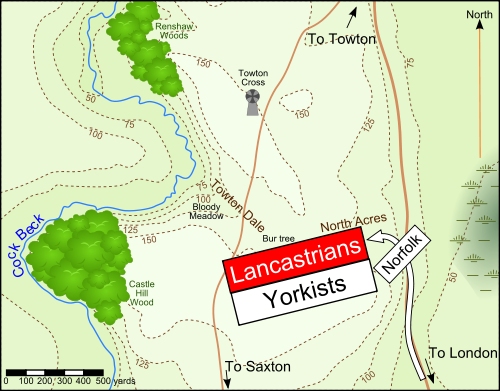 |
| The Turning Point |
| Copyright: Wikipedia |
| Crossing the Cock Beck was now the only way the defeated army could escape. There
was a makeshift bridge of boards at Cocksford around which there was heavy fighting
as the Yorkists tried to prevent the Lancastrians from crossing it to freedom.
The bridge had not been built to support a battling mass of men, and as it gave
way hundreds from both armies plunged into the icy water below, where most of
them drowned or suffocated in the press. Struggling wildly in the water many
were trampled as more people used their bodies as a bridge to the farther shore.
Before long the Cock Beck was running red with blood all the way to the River
Wharfe. Those Lancastrians who came up to find the bridge gone, were slaughtered
in droves. |
| The battle lasted for ten hours, from eleven in the morning until nine at night. It had been agreed at talks before the battle commenced that no quarter would be given by either side so mass slaughter of the fleeing Lancastrians continue through the night and into the next morning. |
| When it was over, men dropped down with exhaustion and slept among the dead and wounded. The Yorkists had scored a decisive and overwhelming victory. |
| Towton is claimed to be the bloodiest battle ever to take place on English soil.
When dawn rose on the 30th. of March, the meadow and North Acres were thick with
corpse. Edward's heralds estimated that 28,000 had been killed, however, this
only applied to those bodies lying on the field, and did not include all those
who perished during the rout, so the real figure is believed to be nearer 40,000.
Of these, according to John Paston, 8000 were Yorkists. Proportionately casualties
were higher here than those for the Battle of the Somme. |
| Because of the massive task of burying so many thousands of bodies, Edward gave
extra wages to the gravediggers. A huge pit was dug at Saxton, in which hundreds
of bodies were buried. Others were interred in another large pit in the Bloody
Meadow, beside the bank of the Cock Beck. The Burial mounds are still visible
at Low Leads, beyond Castle Hill Wood. |
| Henry VI and Margaret of Anjou were in York when the battle was fought. When they were told of the terrible Lancastrian defeat, and that their army had been virtually annihilated, they fled from the city. Although Edward had scored a resounding victory, it was an incomplete one, for Henry, Margaret and their son were still at large and he would not be secure on the throne until they were either dead or he had them in his power. |
| This was in effect the end of the first 'War of the Roses'. And so it came to pass that on Sunday, 28th. of June 1461 Edward was crowned King in Westminster Abbey and his rule was 'welcomed by all'. In reality the war was to continue until 1471 when Henry VI, by then a prisoner of King Edward, mysteriously died in the Tower of London. |
|
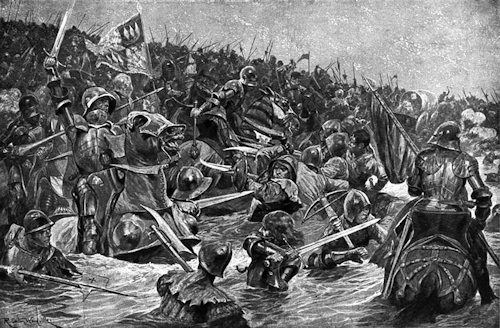 |
| Richard Caton Woodville's - The Battle of Towton |
| Copyright: LIFE Photo Archive |
|
| Return To The History Menu |